
Printable cleaning and disinfection plan
A cleaning and disinfection schedule is the document that sets, area by area and item by item, what is cleaned, with which product, how often and by whom; it belongs to the prerequisite hygiene programmes of the food safety plan, and its follow-up record proves it is applied. List your areas and equipment: you get the plan to fill in and the follow-up record. Free, no sign-up.
Build my planAnd your temperatures, still read by hand?
A cleaning schedule is kept by hand, and rightly so: nobody automates a wipe-down. Temperature readings are a different matter. A KelvinTag sensor measures continuously inside each unit, timestamps at source, and exports the record as a PDF in one click.
The plan stays free, with no sign-up.
Customise
Areas and equipment
8/12Product, dilution and contact time are deliberately left blank: those values come from the data sheet of the product you actually use.
In the print dialog, choose "Save as PDF".
Preview
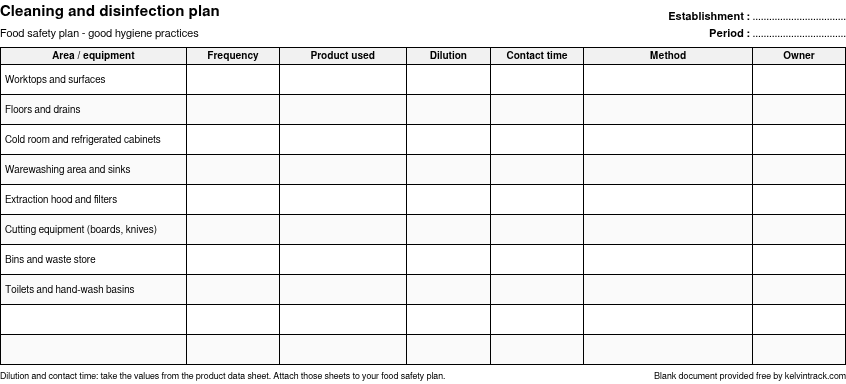
A4 landscapeFood safety plan - good hygiene practices
| Area / equipment | Frequency | Product used | Dilution | Contact time | Method | Owner |
|---|---|---|---|---|---|---|
| Worktops and surfaces | ||||||
| Floors and drains | ||||||
| Cold room and refrigerated cabinets | ||||||
| Warewashing area and sinks | ||||||
| Extraction hood and filters | ||||||
| Cutting equipment (boards, knives) | ||||||
| Bins and waste store | ||||||
| Toilets and hand-wash basins | ||||||
Reference text: Regulation (EC) No 852/2004 on the hygiene of foodstuffs
What a cleaning and disinfection plan must contain
Regulation (EC) No 852/2004 requires the result, not the document: Annex II asks that premises be kept clean and in good repair (Chapter I) and that equipment and utensils be cleaned and, where necessary, disinfected frequently enough (Chapter V). The plan is how the food safety plan shows how that result is achieved. For an inspection to read it, each line answers seven questions.
- What - the area, surface or piece of equipment, named the way the kitchen names it: worktop, slicer, cold room, floor, handles.
- When - the frequency, decided from the risk: after each use, at the end of service, weekly, monthly.
- With what - the product, its dose and its dilution, as its data sheet gives them; the sheet stays within reach.
- How - the method and the equipment: clean first, rinse, disinfect, rinse if the product requires it, dry.
- How long - the disinfectant's contact time, copied from the data sheet, because it is the condition most often lost.
- Who - the person responsible for each line, and the one who checks.
- The proof - the follow-up record, dated and signed at each pass; that, not the plan, is what an inspection reads.
The generator above produces the plan with these columns, area by area, and the follow-up record that goes with it. The values (frequency, product, dose, contact time) are left to fill in: they are your products' and your establishment's, not ours.
Clean, then disinfect: two actions, not one
Cleaning removes soil and organic matter; disinfection reduces what remains. Reversing or merging the two does not work: a disinfectant applied to a still-greasy surface works poorly: organic matter makes it lose much of its effectiveness. It is the most common mistake, and it is invisible - the surface looks clean.
The second condition routinely lost is contact time. Every disinfectant needs to stay on the surface for a stated period, given on its data sheet. Wiped straight off, it does not disinfect, whatever it cost. That is why the plan above gives that duration its own column instead of leaving it to memory.
Finally, a plan without a record proves nothing. The plan describes what you intended; the dated, signed follow-up record shows it happened. At an inspection, it is the second one you are asked for.
Related resources: the food safety plan template · the temperature log sheet
Frequently asked questions
It is part of the good hygiene practices underpinning the food safety plan required by Regulation (EC) No 852/2004. The regulation does not mandate a format: it requires cleaning to be controlled, described and verifiable. A plan pinned to the wall but never filled in proves nothing.
Cleaning removes visible soil and organic matter; disinfection reduces the micro-organisms left behind. Order matters: a disinfectant applied to a greasy surface works poorly, because organic matter makes it lose much of its effectiveness. That is why most protocols run clean, rinse, disinfect, then a final rinse where the product requires one.
Because it is the efficacy condition most often lost. A disinfectant has to stay on the surface for a specific time, stated on its data sheet; wiped off immediately, it does not disinfect. Writing that time into the plan stops it depending on who is on shift.
The completed, signed follow-up record, and the data sheets of the products used. The plan describes what you intended; the record shows it happened. An inspector shown only the first has nothing to verify.
One plan is enough, provided it distinguishes each area and piece of equipment: a cold room, a sink area and an extraction hood need different products, frequencies and methods. That granularity is what separates a useful document from a decorative one.
Cleaning gets ticked. Temperature does not.
A cleaning box gets ticked once a day. A cold room drifts at 3am. KelvinTrack measures continuously, alerts you before the loss, and keeps a timestamped history you can produce at an inspection.
See how it worksOrder now, shipping from the end of October
Deliveries start at the end of October 2026. Not decided yet? Leave your address and we will write once, when shipping begins.
Order the KelvinTag sensorSee also
The other documents in the food-safety file, free to download or generate.
- Temperature log sheetGenerate a blank sheet matched to your cold enclosures and their limits, ready to post in the kitchen.Open
- Food safety plan templateThe full structure of a food safety management system - hygiene practices, HACCP plan, traceability - with your enclosures pre-filled and the questions each section must answer.Open
- Food traceability registerGoods received or opened products: a blank book ready to fill in, with the columns an inspection expects (lot, use-by, temperature on arrival).Open
- Allergen matrixDishes × 14 allergens to tick, or the Annex II list to display: the written document the rules expect front of house.Open
- Storage temperaturesRegulatory storage temperatures by food category: chilled, frozen, hot holding and healthcare products.Open
- Use by and best before datesWhat each date means, what may still be sold or served once it has passed, and the article of Regulation 1169/2011 that says so.Open
- Cold-chain food recallsThe food recalls published on France's RappelConso that cite a cold-chain break: by month, category and storage temperature, with the method and the official notices.Open
- The HACCP methodDefinition, the seven principles of Article 5 of Regulation 852/2004, the twelve steps, foodborne outbreaks and what training actually requires.Open
- Food hygiene inspectionWho inspects, which records you are asked for, and what can follow a visit - from a reminder of the rules to an order to close all or part of the premises.Open
- Temperature mappingWhen it is required (Good Distribution Practice for medicines), the method in six steps, and where the monitoring probe goes afterwards.Open
- Choosing a temperature data loggerThermometer, stand-alone logger or connected sensor: what each one proves, what Regulations 37/2005 and 852/2004 require, and the seven questions to ask before buying.Open
- Cold-chain breakFridge failure, door left open, vaccine out of the fridge: what the texts say, what decides the fate of the goods, the five moves of the first hour and the signals before a breakdown.Open
- Use-by date tracking sheetWhat is in stock and its date, for the daily check: product, lot, use-by or best-before, location, exit.Open
- HACCP and cold-chain glossaryHACCP, CCP, OPRP, TIAC, use-by and best-before dates, chilled and frozen storage, cook-chill, calibration, MKT: each term defined in a few sentences, with its official source.Open
- Mean kinetic temperature (MKT) calculatorPaste a logger's readings and get the MKT, minimum, maximum and readings out of range, computed in your browser.Open
- Food inspection barometerAlim'confiance results aggregated: how France's four hygiene levels are distributed by type of establishment, reason for inspection, region and département, with the method and its limits.Open