
Printable food traceability register
A food traceability register is the book that ties each food item to its lot and its supplier, as Article 18 of Regulation (EC) No 178/2002 requires: goods received on one side, opened products and their secondary use-by date on the other. Pick the register, enter your establishment and print a blank book ready to fill in. Free, no sign-up.
Build my registerThe temperature column can look after itself.
A traceability register covers far more than the cold chain: batches, suppliers, delivery dates. The temperature line, though, has no reason to be written by hand. A KelvinTag sensor measures continuously, timestamps every value at source, and exports the history as a PDF the day you are asked for it.
The register stays free, with no sign-up.
Preview
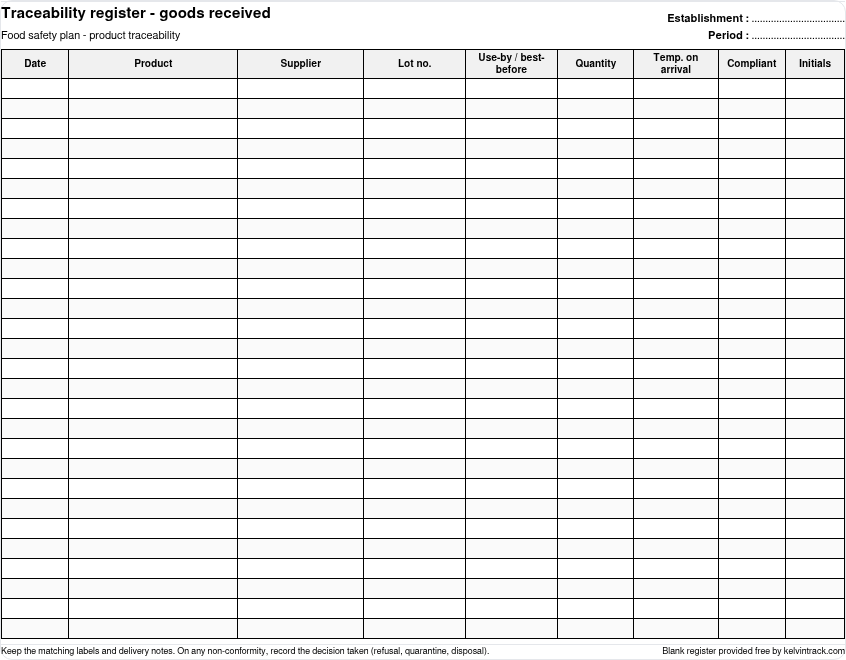
A4 landscape · 28 rowsFood safety plan - product traceability
| Date | Product | Supplier | Lot no. | Use-by / best-before | Quantity | Temp. on arrival | Compliant | Initials |
|---|---|---|---|---|---|---|---|---|
Reference text: Regulation (EC) No 178/2002, Article 18 (traceability)
Food traceability: one step back, one step forward
Traceability is not there to look tidy in a binder: it exists so a product can be pulled from circulation quickly and precisely when something goes wrong. Article 18 of Regulation (EC) No 178/2002 requires you to know who supplied each item and, if you supply other businesses, who you passed it to.
In practice everything hangs on the lot number. While a product sits in its original packaging the lot is readable. The moment it is opened, decanted or repacked that link is lost unless someone wrote it down: that is precisely what the opened-products register and the secondary use-by date are for.
Goods-in checks are where traceability and the cold chain meet. A chilled delivery that arrives out of range is not fixed by putting it away quickly: it is refused or quarantined, and the decision is recorded. It is also the first line an inspector reads.
Related resources: the temperature log sheet · the food safety plan template · use by and best before, what each date means
Frequently asked questions
Yes. Article 18 of Regulation (EC) No 178/2002 requires every food business operator to be able to identify their suppliers and, where relevant, their business customers - the "one step back, one step forward" principle. You must be able to say where a product came from and, if you supply others, where it went.
At minimum, enough to tie a product to its lot: date received, product name, supplier, lot number, use-by or best-before date, quantity, and the temperature recorded on arrival for chilled goods. The initials of whoever checked it are what make the check accountable.
Once a product is opened or decanted, its original date no longer applies: the operator sets a new, secondary date after which it must not be used. How long depends on the product and comes from your sector's good hygiene practice guides and your own food safety plan - it is not the same for every food.
The regulation requires the information to remain available to the authorities without setting one duration for every product; it is judged against the shelf life of the foods concerned. Set the period in your food safety plan and stick to it - that document is what an inspector checks against.
It is recorded at the same moment and on the same register, but it belongs to cold chain control: a chilled product delivered outside its range must be refused or quarantined, and that decision has to be traced. It is where traceability and the cold chain meet, and the most frequently checked point.
The temperature column can fill itself in
KelvinTrack measures your enclosures continuously and keeps a timestamped history. On inspection day, "Inspection mode" generates a read-only link you hand to the inspector, with no account for them to create.
See how it worksOrder now, shipping from the end of October
Deliveries start at the end of October 2026. Not decided yet? Leave your address and we will write once, when shipping begins.
Order the KelvinTag sensorSee also
The other documents in the food-safety file, free to download or generate.
- Temperature log sheetGenerate a blank sheet matched to your cold enclosures and their limits, ready to post in the kitchen.Open
- Food safety plan templateThe full structure of a food safety management system - hygiene practices, HACCP plan, traceability - with your enclosures pre-filled and the questions each section must answer.Open
- Allergen matrixDishes × 14 allergens to tick, or the Annex II list to display: the written document the rules expect front of house.Open
- Cleaning and disinfection planThe area-by-area plan to fill in, plus the daily record that proves it is applied.Open
- Storage temperaturesRegulatory storage temperatures by food category: chilled, frozen, hot holding and healthcare products.Open
- Use by and best before datesWhat each date means, what may still be sold or served once it has passed, and the article of Regulation 1169/2011 that says so.Open
- Cold-chain food recallsThe food recalls published on France's RappelConso that cite a cold-chain break: by month, category and storage temperature, with the method and the official notices.Open
- The HACCP methodDefinition, the seven principles of Article 5 of Regulation 852/2004, the twelve steps, foodborne outbreaks and what training actually requires.Open
- Food hygiene inspectionWho inspects, which records you are asked for, and what can follow a visit - from a reminder of the rules to an order to close all or part of the premises.Open
- Temperature mappingWhen it is required (Good Distribution Practice for medicines), the method in six steps, and where the monitoring probe goes afterwards.Open
- Choosing a temperature data loggerThermometer, stand-alone logger or connected sensor: what each one proves, what Regulations 37/2005 and 852/2004 require, and the seven questions to ask before buying.Open
- Cold-chain breakFridge failure, door left open, vaccine out of the fridge: what the texts say, what decides the fate of the goods, the five moves of the first hour and the signals before a breakdown.Open
- Use-by date tracking sheetWhat is in stock and its date, for the daily check: product, lot, use-by or best-before, location, exit.Open
- HACCP and cold-chain glossaryHACCP, CCP, OPRP, TIAC, use-by and best-before dates, chilled and frozen storage, cook-chill, calibration, MKT: each term defined in a few sentences, with its official source.Open
- Mean kinetic temperature (MKT) calculatorPaste a logger's readings and get the MKT, minimum, maximum and readings out of range, computed in your browser.Open
- Food inspection barometerAlim'confiance results aggregated: how France's four hygiene levels are distributed by type of establishment, reason for inspection, region and département, with the method and its limits.Open