
Printable fridge temperature log sheet
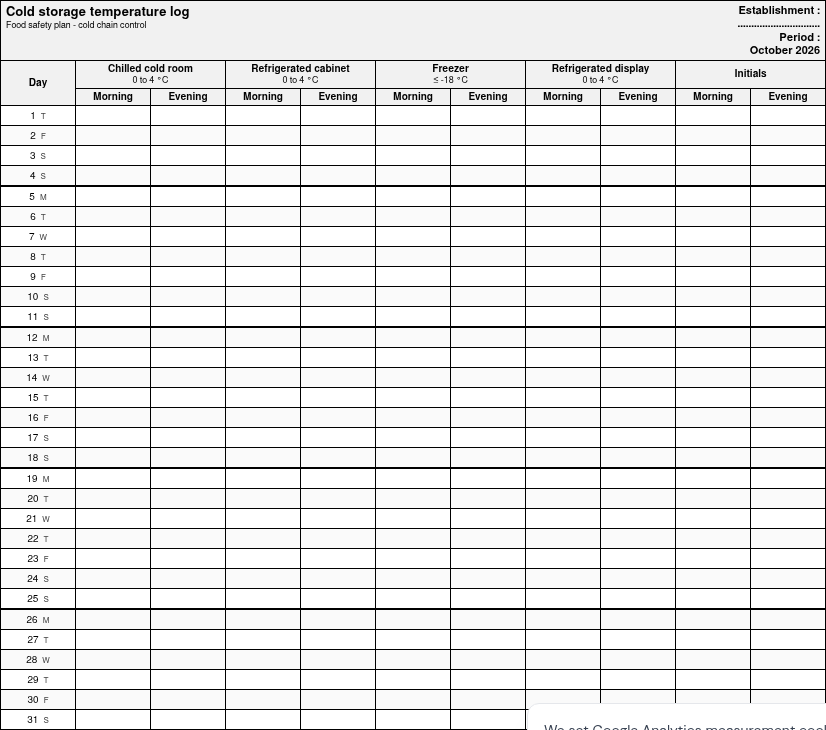
A temperature log sheet is the document on which a food business records, at the frequency its food safety plan sets, the temperature of each cold enclosure, with the date, the time and the initials of whoever took the reading: it is the written proof an inspector compares with the plan's limits. Enter your cold enclosures and their limits, then print a blank sheet ready to post in the kitchen. Free, no sign-up, no email required.
Build my sheetStop doing this by hand.
The sheet does its job, but it does not fill itself in. Two readings a day is 730 lines a year per unit, and on inspection day it is the empty boxes that show. A KelvinTag sensor measures continuously, timestamps at source, and exports the same record as a PDF in one click.
The sheet stays free, with no sign-up.
Customise
31 days on the sheet.
Cold enclosures
4/8Default limits reflect common practice. Use the ones set in your own food safety plan.
Preview
A4 landscape · 31 days| Cold storage temperature logFood safety plan - cold chain control | ||||||||||
|---|---|---|---|---|---|---|---|---|---|---|
| Day | Chilled cold room0 to 4 °C | Refrigerated cabinet0 to 4 °C | Freezer≤ -18 °C | Refrigerated display0 to 4 °C | Initials | |||||
| Morning | Evening | Morning | Evening | Morning | Evening | Morning | Evening | Morning | Evening | |
| 1T | ||||||||||
| 2F | ||||||||||
| 3S | ||||||||||
| 4S | ||||||||||
| 5M | ||||||||||
| 6T | ||||||||||
| 7W | ||||||||||
| 8T | ||||||||||
| 9F | ||||||||||
| 10S | ||||||||||
| 11S | ||||||||||
| 12M | ||||||||||
| 13T | ||||||||||
| 14W | ||||||||||
| 15T | ||||||||||
| 16F | ||||||||||
| 17S | ||||||||||
| 18S | ||||||||||
| 19M | ||||||||||
| 20T | ||||||||||
| 21W | ||||||||||
| 22T | ||||||||||
| 23F | ||||||||||
| 24S | ||||||||||
| 25S | ||||||||||
| 26M | ||||||||||
| 27T | ||||||||||
| 28W | ||||||||||
| 29T | ||||||||||
| 30F | ||||||||||
| 31S | ||||||||||
| Cold storage temperature logFood safety plan - cold chain control | ||||||||||
|---|---|---|---|---|---|---|---|---|---|---|
| Date | Time | Unit | Temp. read | Anomaly observed | Corrective action | Initials | ||||
Reference text: Regulation (EC) No 852/2004 on the hygiene of foodstuffs
What a kitchen log sheet needs to contain
A temperature log sheet exists to prove, after the fact, that the cold chain was under control. For it to do that job at an inspection, it has to answer four questions unambiguously: which enclosure, when, what value, and who took the reading.
- Identification of each enclosure - a meaningful, stable name - not "fridge 1" if its use changes every month.
- The acceptable limits - printed on the sheet itself, so whoever takes the reading knows immediately whether it is compliant.
- The date and time slot - morning and evening in most kitchens, to bracket the service period.
- The value actually read - in degrees Celsius, with no convenient rounding and nothing copied from yesterday.
- The supervisor's initials - a single initial is enough, but it commits someone - that is what separates a reading from a ticked box.
- Corrective actions - on the back or in a dedicated column, whenever a value falls outside the limits.
How to take a temperature reading, in five moves
Whether it is called a log sheet, a record or a temperature chart, the document is the same; what differs from one business to the next is how it is filled in. The reading itself takes five moves.
- 1
Wait for the enclosure to settle
Not right after a delivery nor with the door barely shut: the value read then is that of the opening, not of storage.
- 2
Read the right thermometer
The one inside the enclosure, at the warmest point, often at the top and near the door. The appliance display gives its setpoint or its own probe, not what the food experiences.
- 3
Write the value as read
With the date, the time and your initials. Neither rounded nor corrected: a sheet with no excursion in a year worries an inspector more than it reassures.
- 4
Compare with the enclosure's limit
The one your food safety plan sets for that enclosure, printed at the head of the column on the sheet generated here, not a generic value.
- 5
Out of range: act, and write it down
Move the food, defrost, call the technician, discard if needed, with the time. The sheet must show the excursion and the response; that pair is what an inspection reads.
Two readings a day, at the start and end of service, is the most common practice; the frequency that counts is the one in your food safety plan, which is what an inspector reads next to the sheet. With a logger only the last two moves remain, and the device does the fourth on its own: it compares continuously and alerts the moment the limit is crossed.
Where paper logging breaks down in food service
Paper has a structural flaw: it only measures when someone remembers to. Between two readings, nobody knows what happened. A cold room door left ajar after the morning delivery, a compressor failing on a Friday night, a defrost cycle that runs long - Monday's sheet will show a normal temperature, and the stock will have spent the weekend out of range with no record of it.
There is a credibility problem too. A reading noted at 8am does not prove the fridge was at that temperature at 8am - it proves a box was filled in. Experienced inspectors spot sheets completed in one sitting at the end of the week, and a run of suspiciously regular values invites more scrutiny than a properly documented incident.
This is precisely what automatic recording fixes: measurement is continuous, timestamped at source, and nobody has to remember. Paper keeps its place as a backup and for core-temperature spot checks, which ambient probes do not cover.
Read next: automating your HACCP records · temperature monitoring for food service · the food safety plan template · choosing a temperature data logger
Using Safer Food, Better Business?
In England and Wales, the Food Standards Agency's Safer Food, Better Business (SFBB) pack sets out food safety procedures for small businesses. Its chilled storage safe method recommends setting fridges and chilled display equipment at 5 °C or below, so that chilled food stays at 8 °C or below, which it describes as a legal requirement in England, Wales and Northern Ireland. It asks you to check the temperature at least once a day, starting with your opening checks.
This sheet gives each fridge its own column and each day its own row, so those daily checks sit on one page you can keep with the pack. If something goes wrong, SFBB asks you to write down what happened and what you did in your diary. The sheet is our own template, not an FSA form.
Source: Food Standards Agency, Safer Food, Better Business for caterers.
Frequently asked questions
Cold chain control is required by Regulation (EC) No 852/2004 on the hygiene of foodstuffs, and temperature monitoring is one of the critical control points of a food safety plan. The regulation does not mandate a method: handwritten sheets and automatic recorders are both acceptable, as long as the data is available and consistent at inspection time.
Two daily readings, at the start and end of service, is the most common practice in food service. The frequency that matters is the one written into your own food safety plan - that document is what an inspector checks against, not a universal rule.
Keeping records for at least a year is the generally recommended practice, covering a full cycle of activity and typical product shelf lives. Check the retention period set by your own food safety plan, which may be longer depending on the foods handled.
Never correct the value: record the temperature actually observed, then the corrective action taken (moving stock, defrosting, calling the refrigeration engineer, disposal if required) and the time. A sheet showing no anomaly at all over twelve months reads as suspicious to an inspector, not as diligence.
Yes. A connected recorder measures continuously, timestamps every value and keeps the history with no human action, which removes both forgotten readings and entries reconstructed from memory. Paper sheets remain useful as a backup and for spot checks of core food temperature, which an ambient probe does not cover.
Read the thermometer placed inside the enclosure, not the setpoint the appliance displays, once the door has been shut for a while; write the value as read, with the date, the time and your initials; compare it with the limit set for that enclosure in the food safety plan; and, if it exceeds it, note the action taken. Two readings a day, at the start and end of service, is the most common practice; the frequency that counts is the one in your plan.
It is the grid the readings are written on: one row per day, one column per enclosure and time slot, with the limit to hold at the head of the column and a box for the initials. The sheet generated on this page is that table, preset with your enclosures and their limits, 31 days per A4 page.
Regulation (EC) No 852/2004 requires the cold chain to be controlled and records to be kept; in France, the order of 21 December 2009 sets the maximum storage temperatures: +2 °C for minced meat preparations, +4 °C for cooked dishes and highly perishable foods, +8 °C for other perishable foods, -18 °C for quick-frozen food. The full table, with its sources, is on the storage temperatures page.
The appliance display gives the value of its own probe or its setpoint, not that of the food. The useful reading comes from a thermometer placed inside the enclosure, at the warmest point, often at the top and near the door, read once the temperature has settled after an opening. A minimum-maximum thermometer also shows what happened between two visits; a logger shows it continuously.
The KelvinTrack Android app is free: with a KelvinTag sensor in the enclosure, it reads the temperature over Bluetooth and sends it to the dashboard, also free, which keeps the timestamped history and exports it as a PDF. The sensor is bought once, with no subscription. It does not replace the core probe for cooking and cooling measurements.
Same moves and same sheet: one column per cold room, the limit of the most demanding food at the head, two readings a day or your plan's frequency. Two things change. Where you read: in a cold room the gap between the warmest and the coldest point is real, and the useful measurement is at the worst-case point, the one a temperature mapping finds, not next to the evaporator. And the night: a cold room goes through deliveries, door openings and defrosts between two readings, which a thermometer read morning and evening does not see; that is where a logger replaces the sheet.
Or stop printing these sheets altogether
KelvinTrack measures your enclosures continuously and alerts you before stock is lost. On inspection day, "Inspection mode" generates a read-only link you hand to the inspector: they see your enclosures and 90 days of excursions without creating an account.
See how it worksOrder now, shipping from the end of October
Deliveries start at the end of October 2026. Not decided yet? Leave your address and we will write once, when shipping begins.
Order the KelvinTag sensorSee also
The other documents in the food-safety file, free to download or generate.
- Food safety plan templateThe full structure of a food safety management system - hygiene practices, HACCP plan, traceability - with your enclosures pre-filled and the questions each section must answer.Open
- Food traceability registerGoods received or opened products: a blank book ready to fill in, with the columns an inspection expects (lot, use-by, temperature on arrival).Open
- Allergen matrixDishes × 14 allergens to tick, or the Annex II list to display: the written document the rules expect front of house.Open
- Cleaning and disinfection planThe area-by-area plan to fill in, plus the daily record that proves it is applied.Open
- Storage temperaturesRegulatory storage temperatures by food category: chilled, frozen, hot holding and healthcare products.Open
- Use by and best before datesWhat each date means, what may still be sold or served once it has passed, and the article of Regulation 1169/2011 that says so.Open
- Cold-chain food recallsThe food recalls published on France's RappelConso that cite a cold-chain break: by month, category and storage temperature, with the method and the official notices.Open
- The HACCP methodDefinition, the seven principles of Article 5 of Regulation 852/2004, the twelve steps, foodborne outbreaks and what training actually requires.Open
- Food hygiene inspectionWho inspects, which records you are asked for, and what can follow a visit - from a reminder of the rules to an order to close all or part of the premises.Open
- Temperature mappingWhen it is required (Good Distribution Practice for medicines), the method in six steps, and where the monitoring probe goes afterwards.Open
- Choosing a temperature data loggerThermometer, stand-alone logger or connected sensor: what each one proves, what Regulations 37/2005 and 852/2004 require, and the seven questions to ask before buying.Open
- Cold-chain breakFridge failure, door left open, vaccine out of the fridge: what the texts say, what decides the fate of the goods, the five moves of the first hour and the signals before a breakdown.Open
- Use-by date tracking sheetWhat is in stock and its date, for the daily check: product, lot, use-by or best-before, location, exit.Open
- HACCP and cold-chain glossaryHACCP, CCP, OPRP, TIAC, use-by and best-before dates, chilled and frozen storage, cook-chill, calibration, MKT: each term defined in a few sentences, with its official source.Open
- Mean kinetic temperature (MKT) calculatorPaste a logger's readings and get the MKT, minimum, maximum and readings out of range, computed in your browser.Open
- Food inspection barometerAlim'confiance results aggregated: how France's four hygiene levels are distributed by type of establishment, reason for inspection, region and département, with the method and its limits.Open