
Food safety management system: a free HACCP plan template
A food safety management system is the document that describes how a food business controls its hazards: prerequisite hygiene programmes, the HACCP plan and traceability, with the records that prove it is applied. It is the first document an inspector asks for. Enter your business details and your cold enclosures: you get a template in three parts, with the questions each section has to answer. Free, no sign-up.
Build my templateA written procedure does not take readings.
Your food safety plan describes what must be monitored. It does not monitor it. The temperature part can run without anyone thinking about it: a KelvinTag sensor measures continuously, warns you as soon as a threshold is crossed, and supplies the timestamped history the plan promises.
The template stays free, with no sign-up.
Customise
Cold enclosures
3/10In the print dialog, choose “Save as PDF”.
Preview
A4 portrait · 4 pagesFull-service restaurant
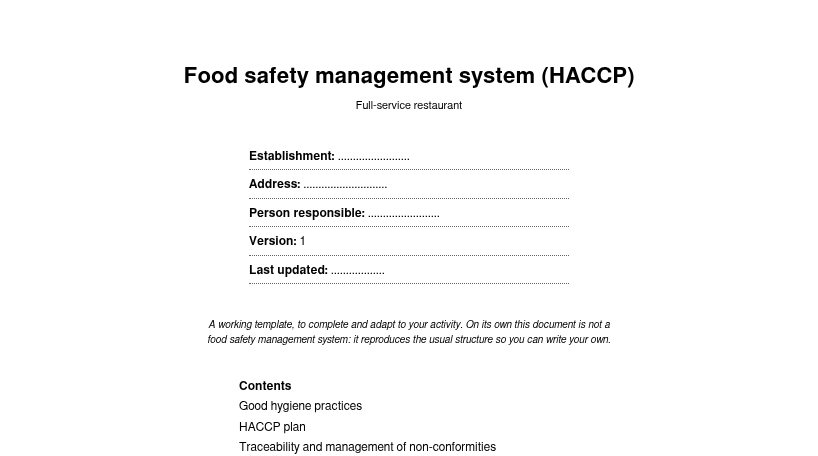
A working template, to complete and adapt to your activity. On its own this document is not a food safety management system: it reproduces the usual structure so you can write your own.
- Good hygiene practices
- HACCP plan
- Traceability and management of non-conformities
Describe the hygiene training your team has had, the workwear and how it is laundered, the hand-washing protocol, and the fitness-to-work and health rules that apply to staff.
Describe the layout of the premises and the forward-flow principle, the condition and upkeep of surfaces, and the maintenance of refrigeration and cooking equipment.
For each area and each piece of equipment, state the product used, its dilution, the frequency, who is responsible and how it is verified. Attach the product data sheets.
Describe the preventive measures, the trap layout (with a bait plan), the contractor if you use one and how often they visit. Keep every intervention report.
State where the water you use comes from and, where relevant, the treatments and checks carried out (ice, process water).
Describe how waste is stored, separated and removed, and how used cooking oil and food waste are handled.
The cold enclosures on site and the limits set for them. Readings are recorded on the temperature log sheet attached to this document.
| Enclosure | Limits | Reading frequency | Responsible |
|---|---|---|---|
| Chilled cold room | 0 to 4 °C | ||
| Refrigerated cabinet | 0 to 4 °C | ||
| Freezer | ≤ -18 °C |
Describe what is done when a limit is exceeded (moving the stock, calling an engineer, disposal) and how the corrective action is recorded.
The HACCP method (Codex Alimentarius), applied to the hazards of your own activity. Complete each principle; cold chain control is covered under 1.7.
| Principle | What it must cover | Your answer |
|---|---|---|
| 1. Hazard analysis | Biological, chemical, physical and allergen hazards specific to your activity. | |
| 2. Critical control points (CCP) | Steps where control is essential: cooking, chilling, cold storage. | |
| 3. Critical limits | The measurable value that must not be exceeded at each CCP (temperature, time). | |
| 4. Monitoring | Who measures, with what, how often, and where the measurement is recorded. | |
| 5. Corrective actions | What is done when a limit is exceeded, and what happens to the product concerned. | |
| 6. Verification | Periodic checks confirming the system works (laboratory analyses, internal audits). | |
| 7. Documentation | Records kept and the retention period you have set. |
One row per CCP identified (cooking, rapid chilling, cold storage, hot holding…).
| CCP | Critical limit | Monitoring | Corrective action |
|---|---|---|---|
Describe the checks made on delivery (temperature, appearance, use-by date, condition of packaging), how batch numbers are recorded, and how delivery notes and labels are kept.
Describe how decanted products are labelled (secondary use-by date), how leftovers are handled and, if you deliver, how outgoing batches are identified.
Describe how non-conforming products are set aside, the withdrawal and recall procedure, who has to be alerted and how the competent authority is informed.
Reference text: Regulation (EC) No 852/2004 on the hygiene of foodstuffs
What a food safety management system contains
It is the reference document your business holds on food safety. It does not describe what the regulation says: it describes what you actually do to comply with it. That difference is what an inspector looks for, and it is why a template downloaded as-is and left blank is worth nothing.
It is usually organised in three parts: the good hygiene practices, covering staff, premises, cleaning, pests, water, waste and temperature control; the HACCP plan, which applies the seven Codex Alimentarius principles to the hazards of your own activity; and the procedures for traceability and non-conformity management, through to withdrawal and recall.
The document describes the procedure; the records prove it is applied. Cold chain control is where that gap shows fastest: the template above carries your enclosures and their limits, but it is the daily readings that count as evidence.
Related resource: the printable temperature log sheet - the record that goes with the temperature control section.
A filled-in HACCP plan example: cold storage
Here is one row of the plan once filled in, for the step almost every business has in common. Each heading follows one of the seven principles; the five preliminary steps and the principles in detail are on the page HACCP method: the 7 principles and 12 steps.
- Step
- Storing chilled food in the cold room
- Hazard (principle 1)
- Growth of pathogenic bacteria if the temperature rises, for example Listeria monocytogenes.
- Critical control point (principle 2)
- Yes, in this example. Depending on your hazard analysis, it may instead sit under good hygiene practice.
- Critical limit (principle 3)
- The maximum temperature set for the unit, here +4 °C. The value that applies depends on your products: the manufacturer's label and your national rules.
- Monitoring (principle 4)
- Thermometer reading at opening and closing, written on the log sheet, or continuous measurement by a sensor.
- Corrective action (principle 5)
- Check the temperature of the food and how long the deviation lasted, set aside anything whose safety cannot be shown, have the unit repaired, record the deviation and what was done.
- Verification (principle 6)
- The person in charge reviews the records, for example weekly, and checks the thermometer.
- Records (principle 7)
- Log sheets, deviation notes and repair reports, kept with the plan.
Frequently asked questions
A food safety management system is the document describing what your business does to keep food safe. It brings together three strands: good hygiene practices, a HACCP plan built on your own hazard analysis, and traceability and non-conformity procedures. It is usually one of the first documents an inspector asks to see.
Regulation (EC) No 852/2004 on the hygiene of foodstuffs requires food business operators to put in place procedures based on HACCP principles and to be able to demonstrate them. A written food safety management system is the usual form that obligation takes, and what is produced at an inspection. Equivalent requirements apply in the UK and in most other jurisdictions - check your national food safety rules.
No, and that matters: a template cannot be compliant on your behalf. The hazard analysis, the critical control points and the limits you set depend on your activity, your premises and your products. This document gives you the usual structure and the questions to answer; the content has to be yours.
Temperature readings from the cold enclosures, goods-in checks, the cleaning plan follow-up, pest control reports and non-conformity sheets. The system describes the procedure; the records prove it is applied day to day.
It has to be kept up to date: any change of menu, equipment, supplier or supervising staff can change the hazard analysis. That is why the template carries a version number and a last-updated date to fill in at each revision.
The temperature section can fill itself in
KelvinTrack measures your enclosures continuously and keeps a timestamped history. On inspection day, “Inspection mode” generates a read-only link you hand to the inspector, with no account for them to create.
See how it worksOrder now, shipping from the end of October
Deliveries start at the end of October 2026. Not decided yet? Leave your address and we will write once, when shipping begins.
Order the KelvinTag sensorSee also
The other documents in the food-safety file, free to download or generate.
- Temperature log sheetGenerate a blank sheet matched to your cold enclosures and their limits, ready to post in the kitchen.Open
- Food traceability registerGoods received or opened products: a blank book ready to fill in, with the columns an inspection expects (lot, use-by, temperature on arrival).Open
- Allergen matrixDishes × 14 allergens to tick, or the Annex II list to display: the written document the rules expect front of house.Open
- Cleaning and disinfection planThe area-by-area plan to fill in, plus the daily record that proves it is applied.Open
- Storage temperaturesRegulatory storage temperatures by food category: chilled, frozen, hot holding and healthcare products.Open
- Use by and best before datesWhat each date means, what may still be sold or served once it has passed, and the article of Regulation 1169/2011 that says so.Open
- Cold-chain food recallsThe food recalls published on France's RappelConso that cite a cold-chain break: by month, category and storage temperature, with the method and the official notices.Open
- The HACCP methodDefinition, the seven principles of Article 5 of Regulation 852/2004, the twelve steps, foodborne outbreaks and what training actually requires.Open
- Food hygiene inspectionWho inspects, which records you are asked for, and what can follow a visit - from a reminder of the rules to an order to close all or part of the premises.Open
- Temperature mappingWhen it is required (Good Distribution Practice for medicines), the method in six steps, and where the monitoring probe goes afterwards.Open
- Choosing a temperature data loggerThermometer, stand-alone logger or connected sensor: what each one proves, what Regulations 37/2005 and 852/2004 require, and the seven questions to ask before buying.Open
- Cold-chain breakFridge failure, door left open, vaccine out of the fridge: what the texts say, what decides the fate of the goods, the five moves of the first hour and the signals before a breakdown.Open
- Use-by date tracking sheetWhat is in stock and its date, for the daily check: product, lot, use-by or best-before, location, exit.Open
- HACCP and cold-chain glossaryHACCP, CCP, OPRP, TIAC, use-by and best-before dates, chilled and frozen storage, cook-chill, calibration, MKT: each term defined in a few sentences, with its official source.Open
- Mean kinetic temperature (MKT) calculatorPaste a logger's readings and get the MKT, minimum, maximum and readings out of range, computed in your browser.Open
- Food inspection barometerAlim'confiance results aggregated: how France's four hygiene levels are distributed by type of establishment, reason for inspection, region and département, with the method and its limits.Open